The Northeast states continue to take actions that impact biosolids management in other states around the region. This is mainly due to per- and polyfluoroalkyl substances (PFAS) concerns. Moratoriums and bans on biosolids end uses were (again) proposed in several states this legislative session. Here are some of the things NEBRA is watching around the region. See separate article about New York (6/1/26).
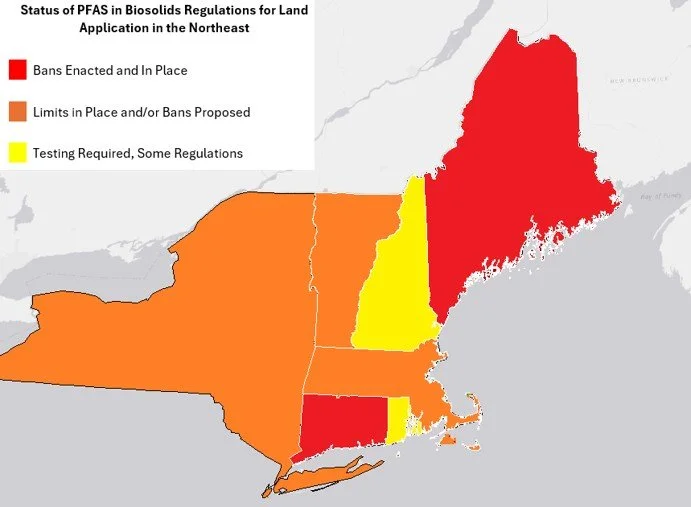
Graphic Courtesy of Charlie Tyler
Maine
There are still no long-term solutions for biosolids management in Maine. After the Maine Water Environment Association (MEWEA) issued a White Paper back in February, calling for a “coordinated, science-based, stakeholder-driven statewide biosolids management plan that addresses capacity, PFAS policy, infrastructure investment, environmental impacts, and long-term system resilience,” the Maine Department of Environmental Protection (DEP) has established a stakeholders group to address dwindling capacity. The MEWEA White Paper points out the risks associated with not having a long-term plan. The Paper does not advocate for a specific management strategy or regulatory outcome, just the need to “develop a durable, statewide biosolids management strategy.”
Under current legislation, Maine water resource recovery facilities (WRRFs) are totally reliant on landfills. The main landfill, Juniper Ridge in Old Town, is state-owned and operated under contract with Casella Resource Solutions. It is projected to be out of capacity in 2028 unless an extension is granted. An application was made and approved by the DEP in October 2024 however it was immediately appealed by the Conservation Law Foundation and the Penobscot Nation. In early 2026, a judge ruled that the DEP must redetermine the public benefit consideration to include the environmental burden on the area around the landfill and factor in sludge drying at the landfill. That process is ongoing with the DEP to schedule a public hearing on the application soon.
Elsewhere in Maine, WM’s biosolids drying facility at its Crossroads landfill in Norridgewock continues to garner attention as it is scheduled to start up very soon. That dryer is key in buying the state some capacity and time as it figures out what to do long-term. If you missed it, NEBRA’s Lunch and Learn webinar in May was on this topic, an interesting and valuable project. NEBRA members can access the webinar recordings here: NEBRA Members — NEBRA.
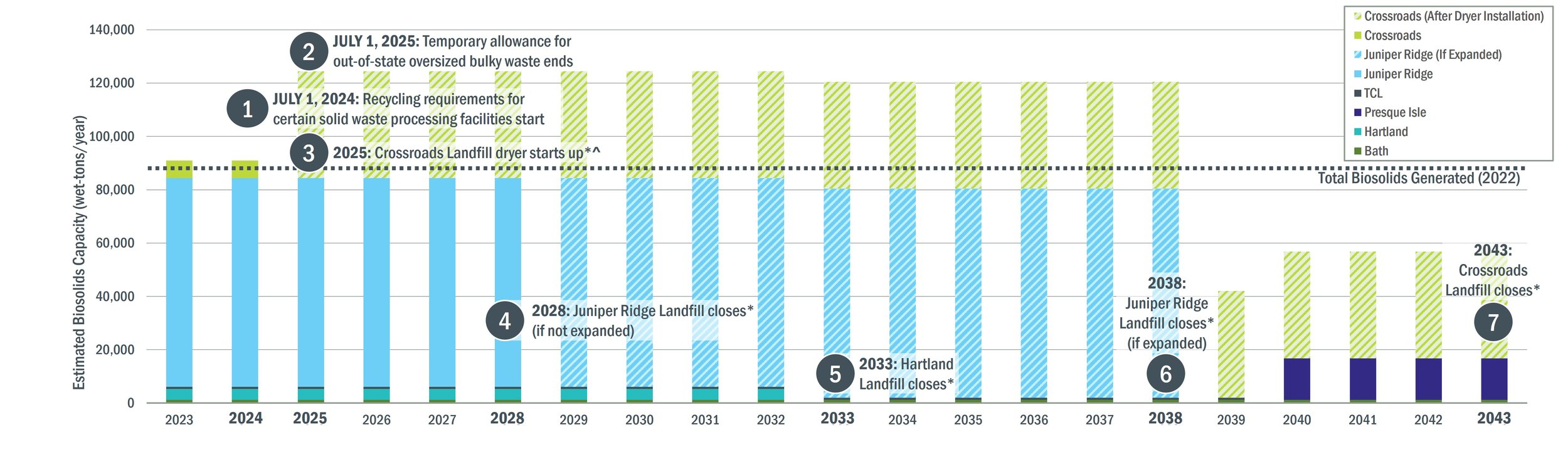
From “An Evaluation of Biosolids Management in Maine and Recommendations for the Future” by Brown and Caldwell in collaboration with MEWEA for the Maine DEP (December 2023)
Planning continues for new biosolids treatment facilities that will require numerous permits. Sanford was one of the first out of the block with a proposed gasification facility to be built by Aries Clean Technology. However, that project is currently on a temporary (180 day) hold to allow the City Council to further consider the plan. Drying and other volume reduction technologies will be the key but they are expensive and in some cases still developing.
Massachusetts
NEBRA has issued several member alerts for Massachusetts this year. An Act to Protect Massachusetts Public Health from PFAS has several provisions of concern and, after having undergone several amendments, is now Bill S.3034. S.3034 is currently in the Senate Ways and Means Committee as the legislature starts to wind down for the season. The major concern is that S.3034 bans beneficial end uses or land application of biosolids, effective June 30, 2028. There is also a section of the bill seeking to give farmers immunity from civil liability related to PFAS contamination which calls out producers/distributors of biosolids and Sewage Sludge Incinerators in particular as being excluded from that liability exemption. In April, proponents of the ban slipped language into the Environmental Bond Bill (or Act to Build Resilience for Massachusetts Communities), specifically Amendment 199 to ban land application and the “sale or distribution of fertilizers or soil amendments made from or containing biosolids”. Thanks to grassroots efforts by the Massachusetts Water Environment Association and its members, Amendment 199 was withdrawn.
The year 2028 is when the Massachusetts Department of Environmental Protection (DEP)’s PFAS and Residuals Technology and Management Study “Part 1” Current and Near-Term Management of Massachusetts Wastewater Sludge predicts there will be nearly 12,000 dry tons of biosolids with no known end use or outlet. That is about 7% of the state’s total production of sludge. And that was before the Hawk Ridge Composting Facility in Maine shut down, another 10,322 dry tons having to find a new place to go.
Regulatory-wise in Massachusetts, DEP contractors are hurrying to wrap up the “PFAS Reduction/Destruction Technology Pilot Evaluation for Massachusetts NPDES POTWs” or permitted water resource recovery facilities (WRRFs). This follows up on its Sludge Study Part 2 - Report Summary - Future Options and Associated Costs for Management of Massachusetts Wastewater Sludge that warned current conventional sludge management capacities (incineration, land application, and landfilling) will likely decrease, both within and outside of Massachusetts affecting disposal costs region wide.
DEP has put $3 million dollars towards a wide-ranging technology piloting project being managed by NEBRA members AECOM and CDM Smith. This piloting project, referred to as “Part 3” of the PFAS and Residuals Technology and Management Study, is working with about a dozen vendors at numerous WRRFs in Massachusetts and elsewhere testing technologies that remove and/or destroy PFAS in wastewater and sludges. The technologies being piloted are primarily liquid stream technologies with the exception of a Super Critical Water Oxidation pilot and testing at an existing Sewage Sludge Incinerator. NEBRA got to tag along to check out the demonstrations going on at the Upper Blackstone Clean Water facility in Millbury, Massachusetts, where foam fractionation and air testing on the SSI was ongoing. The engineering team is under a very tight deadline to complete the pilot projects and report back to the DEP by the end of June.
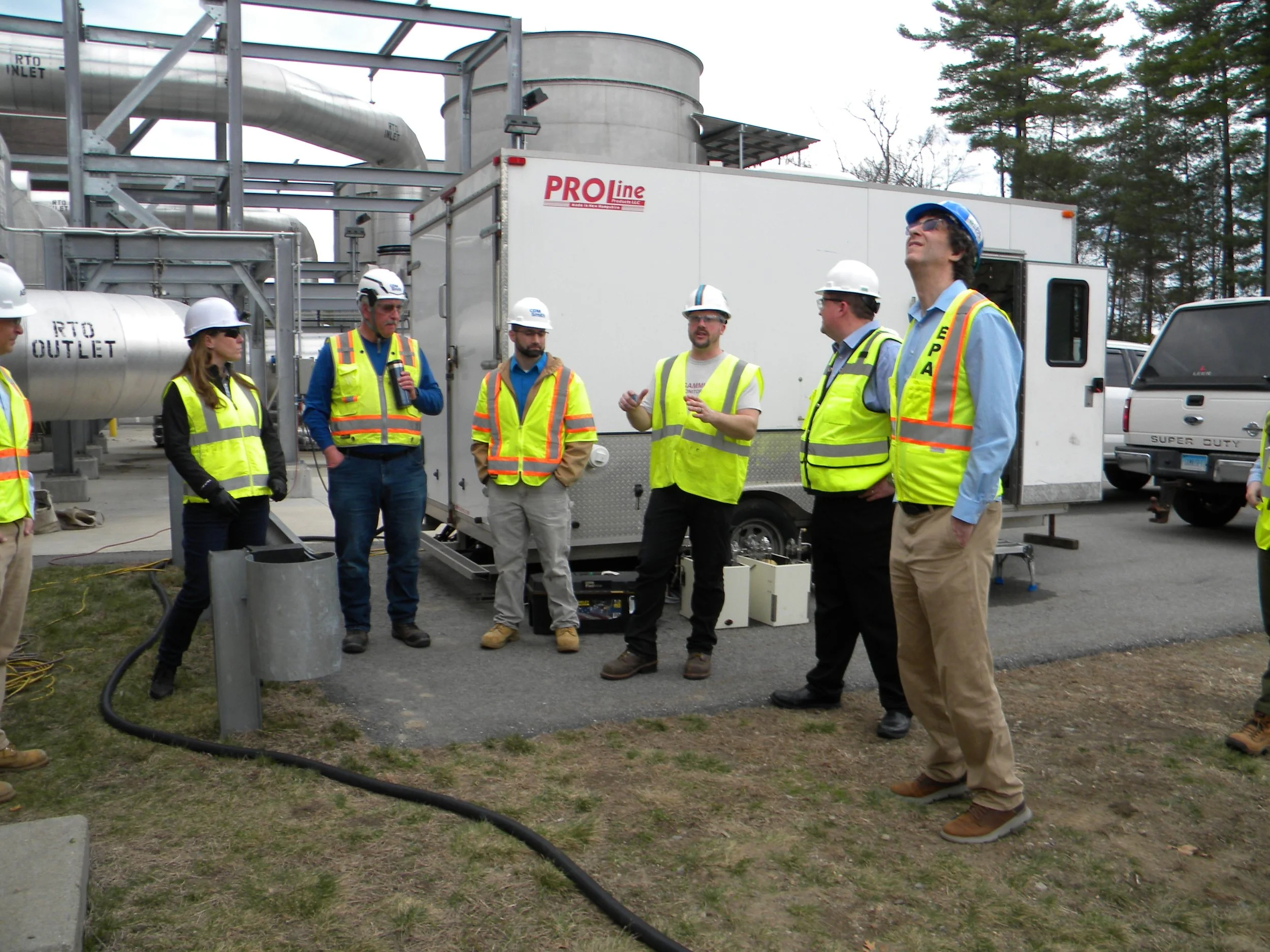
Tour attendees learn about air testing for PFAS at the Upper Blackstone Clean Water SSI. Photo courtesy of Mike Andrus, UBCW.
New Hampshire
NEBRA submitted comments on proposed legislation in New Hampshire (HB1275), weighing in against the proposed 5-year moratorium on beneficial uses of biosolids along with the New Hampshire Water Pollution Control Association (NHWPCA) and the Maine Water Environment Association (MEWEA). Thanks to the hard work of NHWPCA’s Government Affairs Committee and the testimony of numerous NEBRA members, the bill was amended to instead require the New Hampshire Department of Environmental Protection “to develop concentration-based standards for PFAS in biosolids at land-application sites.”
Proposed early in the legislative session, HB1275 was titled “An Act Relative to the Effects of PFAS on Agriculture”. As introduced, it would have had major impacts on sludge/biosolids management that would have reverberated throughout the region. The bill proposed two major actions:
The creation of an Agricultural PFAS Relief Fund to support farmers impacted by PFAS contamination; and
A 5-year moratorium on the land application of sludge or biosolids, effective within 60 days of passage.
NEBRA and NHWPCA sent member alerts and urged their members to make their voice heard, especially wastewater professionals and municipal leaders to warn about the impact on their operations and budgets. MEWEA submitted written testimony, to share their recent experience as a cautionary tale about the unintended consequences of hastily enacted biosolids legislation. Many NEBRA members testified at the hearings, including the Town of Merrimack. HB1275 underwent several amendments with the final version requiring state regulators to come up with standards and initiate public rulemaking by June 30, 2027.
Again, the NHWPCA’s Government Affairs Committee was the key in advocating for a less drastic version of the law that aims to protect farmers. Kudos to NHWPCA for organizing testimony and ensuring the important perspective of clean water operators was heard. There was some good press coverage and one message that got traction was “where will it go?”
Quebec
Back in April, NEBRA submitted formal comments to the Ministère de l’Environnement, de la Lutte contre les changements climatiques, de la Faune et des Parcs as part of the Public Consultation on the Draft Regulation on Agri-Environmental Practices, including the use of biosolids and manures. NEBRA wrote the comments to the Québec government in French, thanks to the help of NEBRA Board member France Pellerin. The main concerns under this proposed new set of regulations included:
Shifting to Provincial Precedence over Municipal Regulations -- NEBRA supported giving the Province authority over agricultural shoreline management.
Extended Spreading Date – the proposed regulation would allow spreading for an additional month, which was welcomed, and would still be governed by established definitions of frozen and snow covered soils.
Cover Crop Requirements -- NEBRA raised some concerns here regarding the proposed requirement for 50% winter soil cover which might not work for some types of residuals.
Nitrogen-Phosphorus-Potassium (NPK) Analysis and Application Rates -- NEBRA cautioned that proposed application rate limits are stricter than in neighboring jurisdictions.
In the end, NEBRA emphasized the importance of upgrading wastewater infrastructure, not just tightening on-farm rules, to reduce nutrient impacts. In Québec, the state of the infrastructure and the frequent overflows also has a significant impact on water quality.
Rhode Island
With the threatened closure of the City of Woonsocket’s sewage sludge incinerator (SSI), public concern is growing for what to do with Rhode Island’s biosolids into the future. The Woonsocket SSI is the largest in the region with the capacity to process 105 dry tons per day of sludges, taking in sludges from other states as well. The Rhode Island Clean Water Association (RICWA) has been working behind the scenes to raise the alarm. In April, the Rhode Island General Assembly’s House of Representatives approved legislation to establish a Special Joint Legislative Commission to study sludge management in Rhode Island. The Senate companion bill has been introduced and is still awaiting a vote at this time.
The legislation, H7532 proposes a 20-member panel including representatives of RICWA and NEBRA, the Narragansett Bay Commission, the RI Department of Environmental Management, the RI Resource Recovery Corporation (manages the state landfill), the RI Department of Administration Division of Planning, as well as representatives of both communities with SSIs (Woonsocket and Cranston).
RI is primarily dependent on incineration and could manage all the states biosolids instate if not for the future proposed closure of the Woonsocket SSI. The age of the SSIs, however, is a concern. Recently, there has been considerable downtime for maintenance. There was an article in the February edition of RI Monthly magazine, beginning and ending with the Woonsocket SSI, that included a quote from NEBRA’s Executive Director as well as the Narragansett Bay Commission and the Town of Bristol, both NEBRA members. Since then, Bristol has decided to end its practice of composting its biosolids with yard waste.
Some in-depth reporting by the Providence Journal has been helpful in advancing the conversation. However, a recent uproar over a proposed biosolids pyrolysis facility at the Quonset Point Industrial Park in North Kingstown, RI, has caused the issue to become more political, even being discussed by Gubernatorial candidates. The original “Sludge Study Commission” bill was amended to include a seat on the commission for RI Clean Water Action. Its purpose is:
“to make a comprehensive study and review of the current state of sludge management in Rhode Island, with an emphasis on the current status of the sludge incinerator at the Woonsocket thermal conversion facility. The commission will study the cost to ratepayers and environmental and climate impacts, and to also identify potential state wide solutions and future opportunities, such as the use of pyrolysis and other technologies and processes for biosolid disposal, to make sludge management more sustainable in Rhode Island.”
The legislation requires the commission to report back to the General Assembly on its findings and recommendations no later than January 5, 2027.
As previously reported, the City of Woonsocket City Council passed a resolution and is taking action to end its SSI operations. That would leave the Rhode Island with inadequate capacity to process all of the sludge generated in-state.
Vermont
The Vermont Department of Environmental Conservation (VTDEC) has published the VT Wastewater Sludge Study 2025 | Department of Environmental Conservation. Prepared by Brown and Caldwell and finalized in March, the “Assessment of Sludge Management Options for Vermont POTWs” – that’s Publicly-Owned Treatment Works – did a deep dive into Vermont’s sludge generation and management and took a look into the future. It provides some recommendations to address vulnerabilities that were identified. Bottom line: Vermont is heavily dependent on others states to help manage its biosolids, as well as a single in-state landfill in Coventry, Vermont.
Sludge production has remained relatively flat in recent years, averaging approximately 11,500 dry tons annually. About 47% is exported to other states (mainly New York) and Canada. About 28% is managed at the Coventry landfill. As expected, the study found that PFAS regulations —both Vermont’s interim screening values (which are about to become regulation) and tightening rules in neighboring states -- are a major driver of risk.
The study took a look at 3 feasible scenarios that would impact Vermont’s management of sludges:
Coventry landfill closes; unable to accept sludges.
New York’s Grasslands organics recycling facility closes – this is a critical outlet for Vermont sludges and there is a real concern that the NY legislature will pass the 5-year moratorium on beneficial end uses in that state.
New regional drying facilities are built (they modeled 5 regional drying facilities throughout the state)
As has been found with other studies, small POTWs lack dewatering and storage capacity and so can be quite vulnerable to disruptions in end use options. Based on the study recommendations, VTDEC plans to further study regional drying facilities and additional volume reduction strategies. However, drying will not address the state’s greenhouse gas emissions and climate concerns unless the end product is beneficially used.
Currently, beneficial end uses are limited primarily to manufactured topsoils, allowed for use (with PFAS limits) for Vermont Department of Transportation projects. VTrans Temporary Moratorium — NEBRA. Vermont’s interim guidance limits for PFAS in land applied residuals are quite strict:
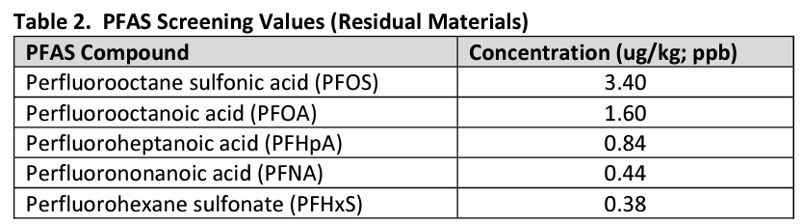
Those interim limits are being proposed as regulations in the VTDEC solid waste management rules currently undergoing public review. Solid Waste Management Rules | Department of Environmental Conservation Comments are due by June 19th.