
NEBRA’s President-Elect Phil Tucker (York, Maine) went to Washington, DC, to represent the organization in a workshop to wrap up the Water Research Foundation study funded by the U.S. Environmental Protection Agency (EPA) back in 2021: Unregulated Organic Chemicals in Biosolids: Prioritization, Fate and Risk Evaluation for Land Applications | Research Project Database | Grantee Research Project | ORD | US EPA. NEBRA was on the WRF Project Advisory team and so Tucker joined NEBRA Research Committee member Kamruzzaman Khan (Hazen and Sawyer) and others who had worked on the project in DC back in late May.
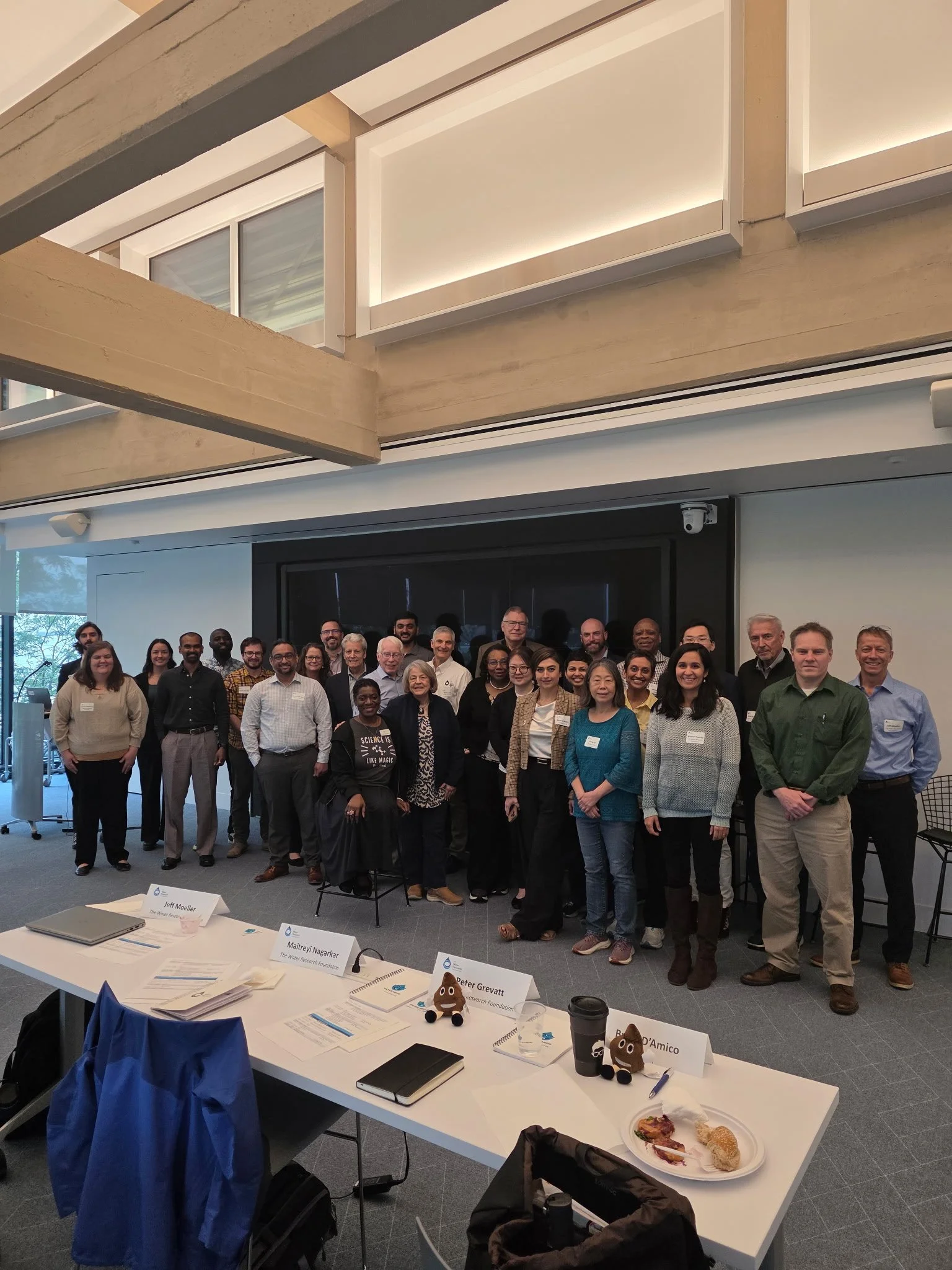
WRF’s EPA Grant Project Team
The results of the research were presented by the Principle Investigators including Lola Olabode (Water Research Foundation), Linda Lee (Pursue University), Drew McAvoy (University of Cincinnati), Jay Gan and Audrey Braun (University of California – Riverside), and Maile Lono-Batura. The project was designed and intended to “Better understanding of the occurrence, fate, and transport of chemical pollutants in land-applied biosolids, particularly those that may persist and/or accumulate in soils and biota”. So far, it has resulted in two peer-reviewed journal articles and twenty presentations about the research project.
Workshop attendees heard presentation from the researchers on analytical method development, unregulated organic compounds (UOC) priority list development, updates on field studies, and a demonstration of the risk calculator that was developed as part of this project.
Research Results
Regarding analytical methods, the research focused on refining EPA Method 1633 (for PFAS) and Method 1694 (for UOCs). Researchers used trial-and-error testing to determine the minimum workable sample mass/volume for analysis. Solid-Phase Extraction was replaced with Enhanced Matrix Removal-Lipid solvent extraction to streamline UOC analysis.
The study started with a list of about 910 compounds (including PFAS) and narrowed that down to 124 priority UOCs (excluding PFAS). Researchers performed a desktop literature review based on occurrence, mobility, persistence, bioaccumulation, and toxicity. Limitations on the review included lack of criteria for the publication timeline which led to the inclusion of some older literature on compounds that are no longer a concern. In addition, because there was no filtering of outliers, the data set became quite large.
The results of the field studies from sites in Virginia and California were varied and mostly confirming what is known about PFAS behavior in the environment. Researchers found that:
PFAS and UOCs tend to accumulate in topsoil
There is a strong positive correlation between PFAS/UOCs and organic carbon in biosolids land-application fields
Long-chain PFAS appear less mobile because they bind strongly to carbon/organic matter
Short-chain PFAS are more mobile and more readily transported
Runoff remains a major concern despite soil binding
Very high PFAS concentrations may exist in soil without significant crop uptake, raising questions about bioavailability
Some UOCs (e.g., phthalates) may be both anthropogenic and naturally occurring
The most frequently detected compounds included pharmaceuticals, flame retardants, and phthalates. The maximum detected concentrations were about 100 parts per billion in the top 30 centimeters of soil and about 50 ppb between 30 to 60 cm depth. The researchers looked at soybeans and observed that they did not uptake PFOS or ETFOSA precursor compounds. Soybeans did uptake some short-chain PFAS. They also found that PFAS from secondary-effluent irrigation water was more bioavailable and more readily taken up by plants than PFAS associated with biosolids.
One concerning finding from the bench-scale study into the fate of PFAS in the field, was that between 20 to 80% of PFAS disappear, about 40% disappeared during windrow composting operations. This has raised new research questions and the need to distinguish whether PFAS are actually degrading, transforming, or becoming unavailable/bound in the soil.
UOC Risk Calculator
Dr. Drew McAvoy from the University of Cincinnati presented on the Risk Calculator developed for this project and supported financially by all the biosolids associations including NEBRA. Professor McAvoy demonstrated the risk calculator using triclosan as an example, using the EPA’s draft risk assessment scenarios.
What they are calling the UCL Risk Calculator v6 is an Excel spreadsheet which uses Virtual Basic to model risks of contaminants through biosolids. It uses information in EPA’s CompTox Chemicals Dashboard and the EPA Exposure Factors Handbook (2011 Edition) as well as the scenarios EPA laid out in its January 2024 risk assessment for PFOA and PFOS in biosolids. You enter the CAS (Chemical Abstract Service) number for the UOC of interest and some other basic information to run the model. The Risk Calculator will be very useful as a screening tool. It is expected to become publicly available later in the year.
In the midst of discussion about this valuable tool resulting from this grant project, there were concerned raised about potential misuse or intentional misinterpretation of the results by stakeholders. This led to a discussion about the importance of careful science communication, especially to Legislators and the general public – and even industry stakeholders and clients need to understand the implications and limitations of these models. Contextualizing that risk, or putting it into perspective with other risks, will be very important.
NEBRA and its members look forward to the final report on Unregulated Organic Chemicals in Biosolids: Prioritization, Fate and Risk Evaluation for Land Applications and the release of the Risk Calculator later this year.