
The recycling to soils of biosolids—treated and tested sewage sludge—continues to be challenged, despite decades of research and experience.
Any day, we can find challenges here and there around the continent. When compared to the thousands of successful biosolids recycling programs that are ongoing—many for decades—these local debates are few and far between. But they are important. They are opportunities for dialogue, for advancing public knowledge, for advancing best practices.
Social science research on biosolids use and practical experience have demonstrated the need for open communications, sharing of accurate information, and building of trust with communities in which biosolids programs operate.
This is exactly what regional biosolids associations, the National Biosolids Partnership (NBP), and state and provincial biosolids committees do. These independent groups of expert professionals advance research and best management practices. They lead the way toward making biosolids management sustainable.
Biosolids groups do not come free; they are the products of countless volunteer hours and voluntary contributions from diverse stakeholders. They run efficiently on modest budgets, driven by their vision of biosolids and other residuals as solutions to myriad environmental challenges: depleted soils, disturbed sites, greenhouse gas emissions,....
Are you involved in biosolids management? Do you value the research and information that supports your work? Do you want to see the field continue to advance? It won't continue without your contribution, large or small. Get involved and help fund your local biosolids organization. There is no more efficient way to insure your biosolids management efforts. And to those already involved: THANK YOU! WELL DONE!
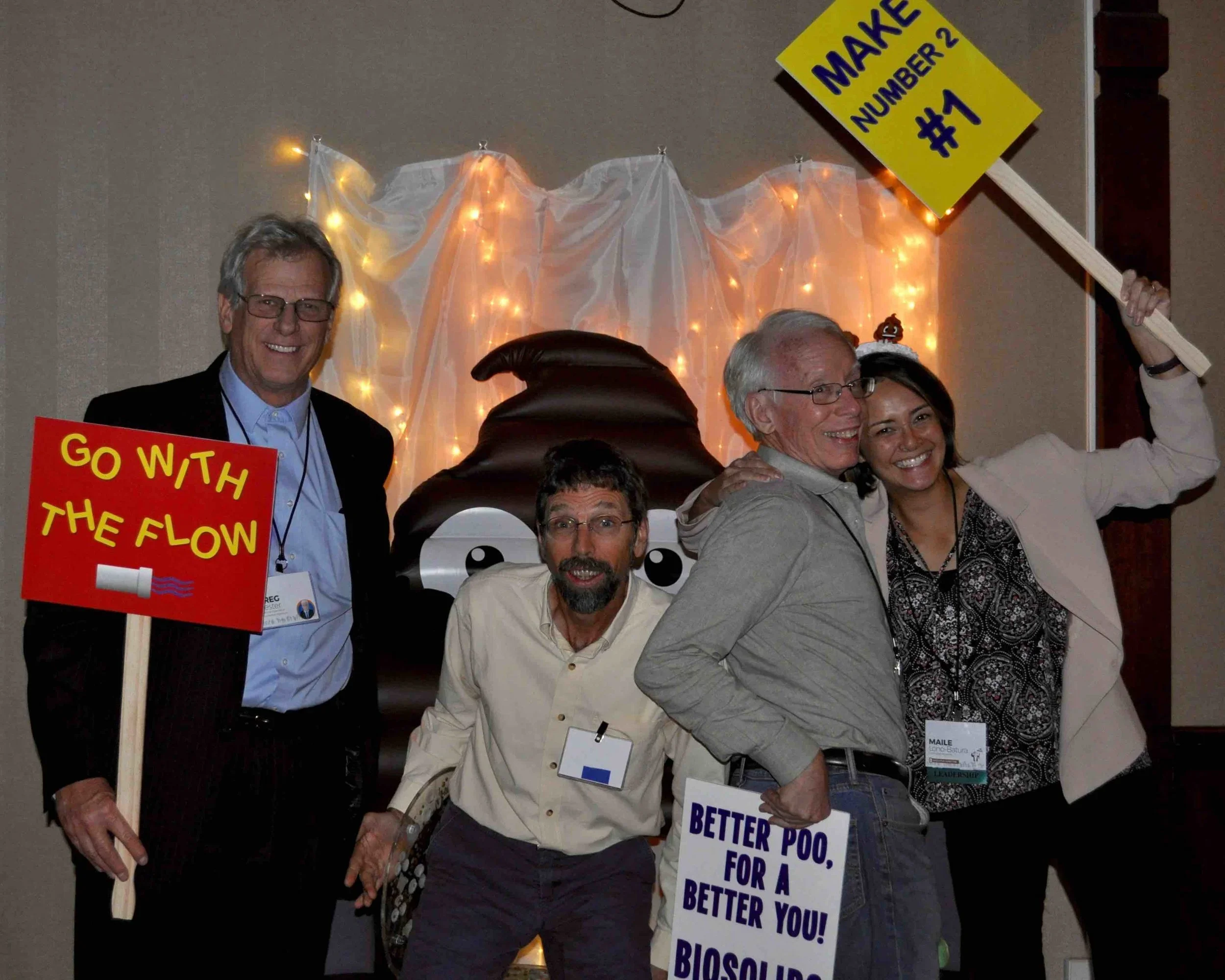
Staff of the leading regional biosolids groups celebrate decades of success at NW Biosolids' "BioFest," Oct. 2017.
L to R: Greg Kester, CASA; Ned Beecher, NEBRA (20 years); Bill Toffey, MABA (20 years); Maile Lono-Batura (30 years).
Northwest Biosolids, the first such group to form (1987), has fostered cutting edge research and the innovation of myriad exemplary biosolids recycling programs throughout the Northwest, achieving ~100% recycling of wastewater solids in the region. Yet even there, challenges occur: in the mid-2010s, NW Biosolids combatted Wahkiakum County's short-sighted ban on Class B biosolids recycling. Look at NW Biosolids's great resources.
The National Biosolids Partnership (NBP) has set its sights on the highest standards, encouraging biosolids management programs to adopt environmental management systems that force continual improvements and focus on measurable outcomes related to environmental impacts and interactions with interested parties, verified by independent, third-party audits. From Orange County and LA in California, to Orange County, FL and LA (Lewiston-Auburn), Maine, and points in between (Chicago, IL; Lawrence, KS; Littleton, CO; St. Cloud, MN; Chattanooga, TN; Atlantic County, NJ; etc., etc.) - as well as Moncton in Canada - select biosolids management programs have raised the bar for quality and sustainability. More than 12% of U. S. biosolids are managed under these programs.
The Mid-Atlantic Biosolids Association (MABA), which encompasses NY, NJ, DE, PA, MD, VA, etc., has advanced some of the most critical primary biosolids research of this century, including understanding of odor generation and pathogen indicator regrowth. MABA holds stellar research and technology symposia and was the leader in creating the Biosolids Land Appliers' certification program with ABC.
The Southeast Biosolids Association (SEBA) was formed in 2023 and is currently seeking and assisting members from NC, SC, GA, AL, and FL. SEBA engages in biosolids education and advocates for beneficial use of biosolids across the Southeast. Get involved today to advocate for resource recovery and ensure a sustainable future for biosolids management in the region.
Leading state biosolids groups and committees include the Virginia Biosolids Council (VBC), the California Association of Sanitation Agencies (CASA) Biosolids Program (playing a critical role in ensuring biosolids are recognized resources in the state's sustainability initiatives) , the Rocky Mountain WEA Biosolids Committee, the Texas WEA Biosolids Committee (which holds a regular biosolids conference), the Florida WEA Biosolids Committee, and the WEA of Ontario (WEAO) Residuals & Biosolids Committee (which has produced excellent seminars, notable research summaries on microconstituents, amongst other topics, and the best biosolids video).
Where would biosolids management be without these biosolids groups' efforts? Would we be maintaining a ~60% recycling rate in the U. S. and ramping up biosolids recycling in Canada?
Get involved and help fund your local biosolids organization. There is no more efficient way to insure your biosolids management efforts.
Regional Biosolids Groups
California Association of Sanitation Agencies (CASA) Biosolids Program
Mid-Atlantic Biosolids Association (MABA)
Northwest Biosolids (NBMA)
Southeast Biosolids Association (SEBA)
Virginia Biosolids Council (VBC)
State & Provincial Biosolids Committees
These committees maintain web pages and/or sponsor biosolids trainings and/or conferences.
Florida Water Environment Association Biosolids Committee
Indiana Water Environment Association (IWEA) Biosolids Committee
Michigan Biosolids Team - WEA of Michigan
New England Water Environment Association (NEWEA) Residuals Management Committee
New York Water Environment Association (NYWEA) Residuals & Biosolids Committee
North Carolina AWWA-WEA Resource Recovery & Reuse Committee
Ontario: Water Environment Association of Ontario (WEAO) Biosolids Committee
Rocky Mountain Water Environment Association (RMWEA) Biosolids Committee
Texas: Water Environment Association of Texas (WEAT) Biosolids Committee
National U.S. Wastewater & Biosolids Groups
National Biosolids Partnership
Water Environment Association (WEF)
Water Research Foundation
National Association of Clean Water Agencies (NACWA)
U. S. EPA Biosolids Program - Washington, DC
National Canada Wastewater & Biosolids Groups
Canadian Water & Wastewater Association / Association canadienne des eaux potables et usées
Canadian Water Network / Réseau canadien de l'eau
Canadian Council of Ministers of the Environment
Environment Canada
Regional - Northeast
New England Water Environment Association (NEWEA)
New England Interstate Water Pollution Control Commission (NEIWPCC)
States / Provinces - Regulatory Agencies - Northeast
Connecticut DEEP (no biosolids/residuals-specific regulations)
Maine DEP: residuals, sludge, & composting
Massachusetts DEP: residuals & biosolids
New Hampshire DES: residuals management
New York DEC: composting and organic materials management
Rhode Island DEP: wastewater treatment facilities
Vermont DEC: residuals management section
New Brunswick Environment & Local Government
Newfoundland Environment & Conservation
Nova Scotia Environment: biosolids
Ontario: biosolids
Prince Edward Island: sludge, septage, and biosolids
Quebec: fertilizing residuals (including biosolids)
