
What if what’s left still has something to give?
Every day, homes, communities, farms, and industries use water and resources to make the things we need. And every day, those processes leave materials behind.
For generations, our instinct was simple: dump them.
But many of these materials still contain valuable nutrients and organic matter. With the right treatment, testing, science, and oversight, some can safely be put back to work—improving soils, supporting agriculture and forestry, restoring land, and reducing our reliance on finite or imported resources.
That’s beneficial use.
Don’t just dispose. Reimagine.
When the materials society produces are responsibly put back to work, we create new value from what remains for a more resourceful future.
What are biosolids?
Wastewater flows from our homes, businesses, institutions, and communities to wastewater treatment facilities, where solids are separated and clean, treated water is returned to the environment. The solids left behind are further treated to reduce pathogens and meet stringent regulatory requirements before they’re ready for responsible reuse.
Biosolids aren't simply untreated sewage. It’s nutrient-rich organic matter that can enrich soil, turning waste into a valuable and mutually beneficial resource.

What are residuals?
Industrial operations in agriculture, forestry, pulp and paper, and food processing generate ‘leftovers’—organic matter with properties that are still useful. A residual that one operation no longer needs can become a soil amendment, an essential ingredient in manufactured soil, a resource for land restoration, or an input for another productive use.
Disposal is neither the only option or the best. This is the circular economy: one industry's leftovers can become another’s indispensable resource.

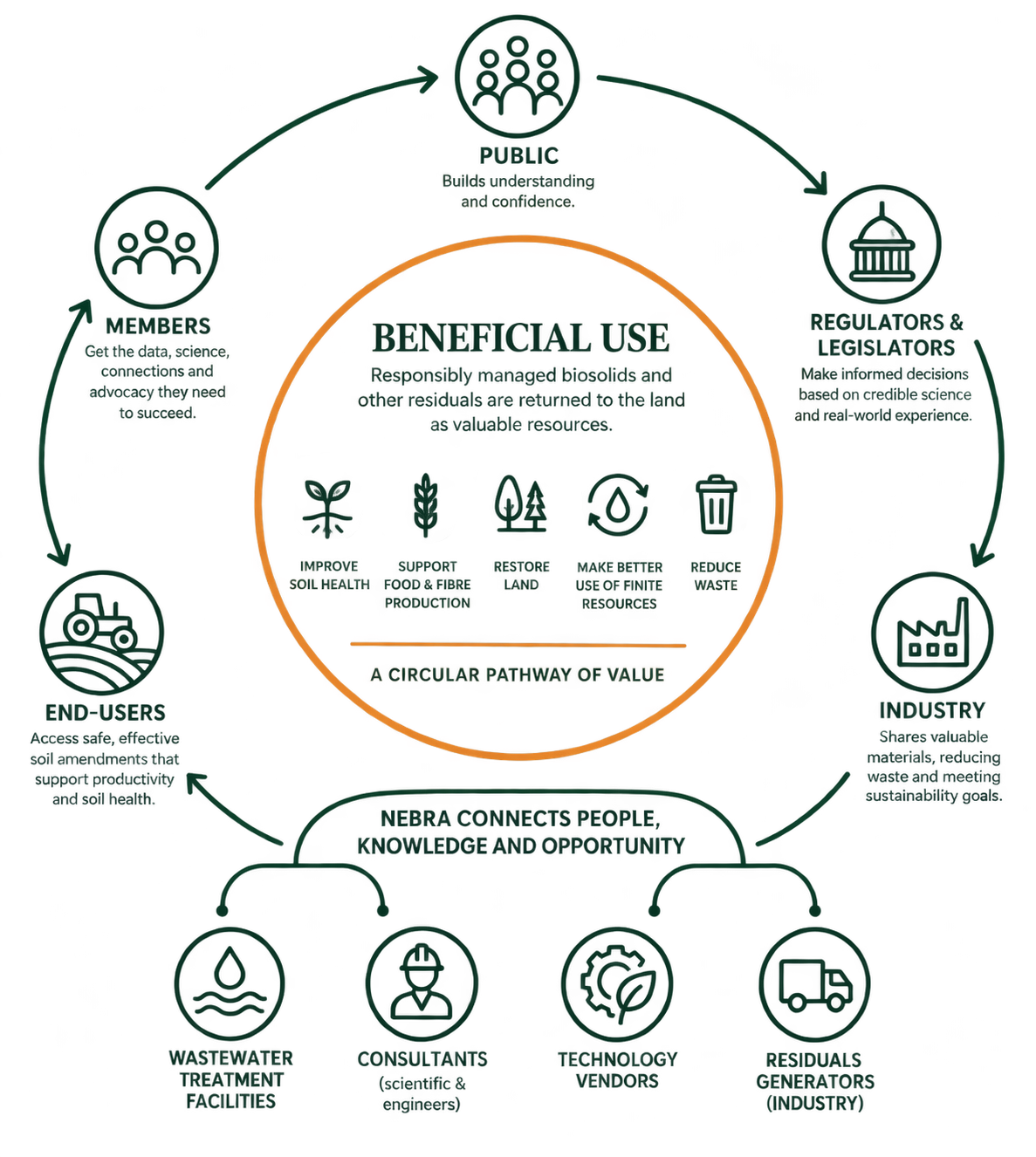
NEBRA’s practical, real-world outcomes:

Improve soil health
We can use organic matter and nutrients to maintain and extend productive soil.

Support food and fiber production
We can recycle nutrients for energy independence and sustainable agriculture and forestry.

Restore land
We can use suitable materials to establish soil and vegetation on degraded or disturbed land.

Reduce resource demand
By recovering nutrients and already-existing materials, we don’t need to manufacture or import more.

Reduce waste
By reusing still-productive materials, we divert organics and nutrients from landfills.

Is it safe?
The land is our shared inheritance. The way we take care of it needs scrutiny—particularly when reusing wastewater, biosolids, or industrial material.
There are many substances we don't want accumulating in our communities and ecosystem. Scientists, regulators, treatment facilities, and the industries that generate these materials work together through NEBRA to understand and mitigate contaminants such as PFAS and microplastics.
To earn public trust, the people of NEBRA follow the evidence, support research, monitor emerging science, improve treatment and technology, and prove the best practices that put public health and the environment at the absolute forefront.