
Biosolids are the nutrient-rich organic byproducts resulting from wastewater treatment. Biosolids have been treated and tested and meet strict federal and state or provincial standards for use as fertilizers and soil amendments.
Biosolids provide plant nutrients and organic matter to soils. They can also be used to produce renewable energy through digestion and production of methane ("biogas") or by drying and thermal processing.
There are two classes of biosolids defined by regulations: Class B and Class A.
Class B biosolids still contain some pathogens (but less than untreated animal manures, for example) and must, therefore, be managed at sites with little public contact, in accordance with regulations. Site permits for use of Class B biosolids are required in New England, New York, and eastern Canadian provinces.
The WEF’s Words on Water podcast covers biosolids, with episodes on benefits & safety (#37), biogas & renewable energy (#42), biosolids & climate change (#45), communicating biosolids (#99), science of PFAS in water treatment (#123), biosolids in uncertain times (#125). See also the WEF Biosolids Position Statement, Sept. 2020.
Most Class B biosolids are used on farms, in highly-managed forestry/silviculture, and/or for land reclamation work on sites with little public contact. These uses of Class B biosolids are safe, because further reductions in pathogens are achieved by natural forces in the environment - sunshine, competition with other bacteria, and weather conditions - that kill off remaining pathogens.
Class A biosolids are virtually free of pathogens, and some - such as cured composts and heat-dried biosolids pellet fertilizers – can be used anywhere. Class A products also include manure-like products that have been highly treated but may still be odorous and best used and managed like Class B biosolids.
The Scientific Basis
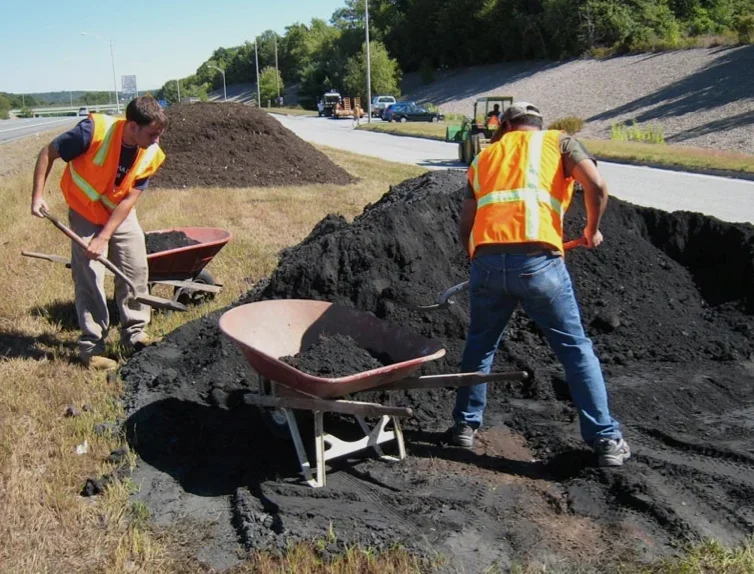
Univ. of Rhode Island research on use of biosolids composts for roadside turf grasses, 2011
Modern biosolids recycling policy and practice rests on a body of scientific research, review, and debate conducted for more than 40 years. A large proportion of government and university scientists working with biosolids have come to believe that biosolids recycling in accordance with current laws and best management practices represents "negligible risk" (this is the finding of the 1996 National Research Council review of the federal biosolids program).
Still, there continues some discussion regarding new angles in the practice of recycling biosolids and other residuals. We at NEBRA believe that this robust scientific analysis and debate will lead to even better practice and policy.
There are several key documents that provide an overview of the scientific basis for biosolids management. These include the U. S. EPA risk assessment and two reviews by expert panels of the National Research Council of the U. S. National Academies of Science. These summary reviews represent the scientific consensus on this topic.
A Regulatory Overview in the Eastern United States and Canada
The majority of wastewater solids (sewage sludges) produced in the U. S. and Canada are treated, tested, and recycled to soils as biosolids. Many are also used to generate renewable energy.
U.S. wastewater solids used & disposed, 2004: 7.18 million U. S. tons (dry weight). Recycled to soils: ~55%
Canada wastewater solids produced, 2004: 860,000 metric tonnes (dry weight). Recycled to soils: ~33%.
A National Biosolids Regulation, Quality, End Use & Disposal Survey (NEBRA et al., 2007)
Enabling the Future: Advancing Resource Recovery from Biosolids (2013)
New England Water Environment Association (NEWEA) Statement on Renewable Energy from Wastewater (January 2012)
Water Environment Federation (WEF) Biosolids Policy Statement (December 2011)
Global Atlas of Excreta, Wastewater Sludge, and Biosolids Management (UN-HABITAT/GMSC, 2008)
“You have to take my sludge!” - NEWEA Journal, Fall 2016.
Current Biosolids Use, Regulatory Trends, and Public Perceptions in New England, 2012
Petite histoire du recyclage des biosolides municipeaux au Québec, partie 1: de 1967 à 2004
Marc Hébert, M.Sc., agr.Petite histoire du recyclage des biosolides municipeaux au Québec, partie 2: de 2005 à aujourd'hui
Marc Hébert, agr.Wastewater Solids Management - Atlantic Canada Perspective (Doucette/CBCL, 2013)
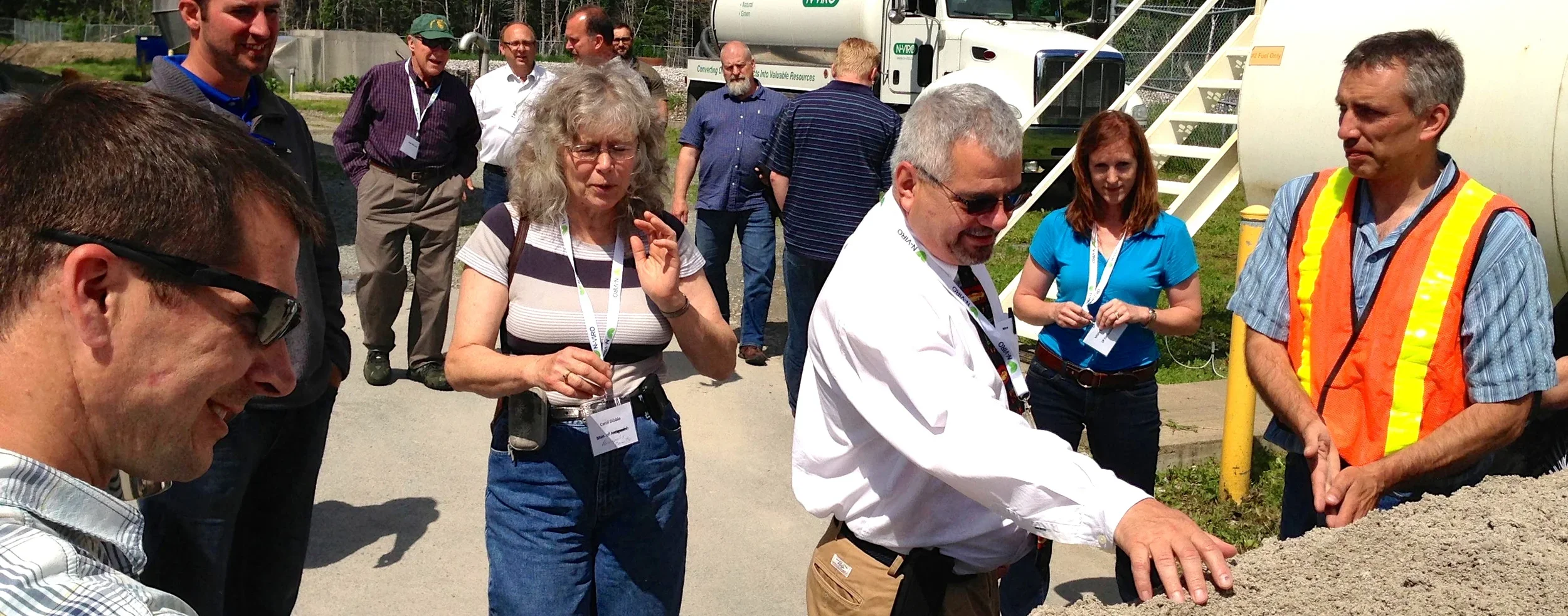
Checking out the Halifax, NS biosolids product during a tour of the NViro-operated facility
RESOURCES
Biosolids - Naturally Sustainable (superb introduction to biosolids by WEAO, in English/en français)
The U. S. EPA biosolids website - excellent information & presentation (Jan. 2018)
Introduction to Land Application of Biosolids - click "Training" tab (2014, Virginia Tech University webinar, 3 parts)
Fertilizing with Biosolids, February 2015, guidance from Pacific NW Extension (WA State, OR State, & Univ. of ID)
DETAILED 3-PART SLIDESHOW - developed by the National Biosolids Partnership (Dec. 2012):
Part 1 - Federal & State Regulations
Part 2 - 40+ Years of Research & Experience
Part 3 - Trends & Drivers: Focusing on Resource RecoveryBiosolids Beneficial ReUse Fact Sheet, Vermont Department of Natural Resources / Dec., 2015
Biosolids 101, October 2012. Slides from a National Biosolids Partnership webinar & workshop.
Options for Biosolids Use or Disposal in New England & Eastern Canada, April 2011. Summarizes pros and cons of various biosolids beneficial use & disposal options.
Biosolids FAQ (a detailed discussion of commonly asked questions)
Biosolids Management fact sheets by NEIWPCC (including land application, composting, & incineration)
