
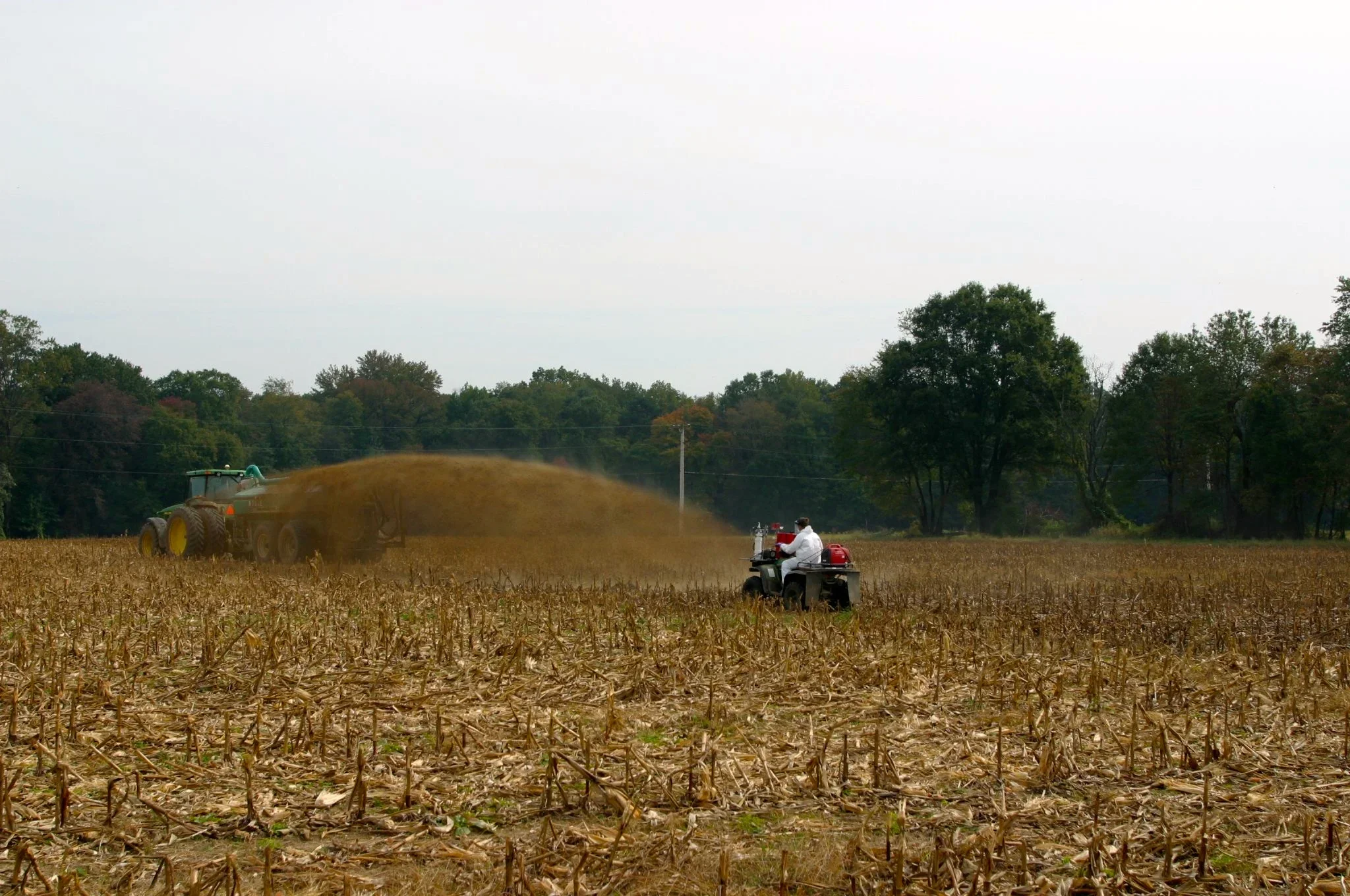
National bioaerosols research included testing at a Maine farmland application of biosolids
Biosolids - Wasting a valuable resource or being resourceful with a valuable 'waste’? Research scientists rebut concerns raised in Canada (2016)
Risks Associated with Application of Municipal Biosolids to Agricultural Land, a comprehensive literature review from Ryerson University (2015)
The scientific process depends on critical peer review and debate. Modern biosolids recycling policy and practice rests on a body of scientific research, review, and debate conducted for over 40 years.
A large proportion of government and university scientists working with biosolids have come to believe that biosolids recycling in accordance with current laws and best management practices represents "negligible risk" (this is the finding of the 1996 National Research Council review of the federal biosolids program; see below).
Still, there continues some discussion regarding new angles in the practice of recycling biosolids and other residuals. We at NEBRA believe that this robust scientific analysis and debate will lead to even better practice and policy.
Below are the key documents that provide an overview of the scientific basis for biosolids management, including biosolids application to soils. These documents, including U. S. EPA risk assessment and two reviews by expert panels of the National Research Council of the U. S. National Academies of Science, represent the scientific consensus on this topic.
Today, some research continues on the traditional research topics in this field: trace elements of concern (heavy metals), priority organic chemicals, and bioaerosols. Those topics have, by now, been quite thoroughly addressed in the scientific literature. But there are other topics of current interest:
What are the impacts of traces of chemicals in wastewater and biosolids that come from pharmaceuticals and personal care products (PPCPs), also known as "microconstituents"?
What are the impacts of particular treatment technologies, including possible triggering of bacteria reactivation and regrowth in some Class B biosolids?
How do biosolids generate malodors and what process controls can be adopted to stop this from happening?
How can energy production from biosolids be optimized, for example, with anaerobic digestion?
What are the carbon emissions from various biosolids management processes, and how can biosolids management programs minimize those emissions and maximize efficiency and sustainability?
NEBRA continues to track progress on these and related research topics and reports them here and in NEBRAMail.
Federal EPA Risk Assessment & Reviews of Biosolids Recycling
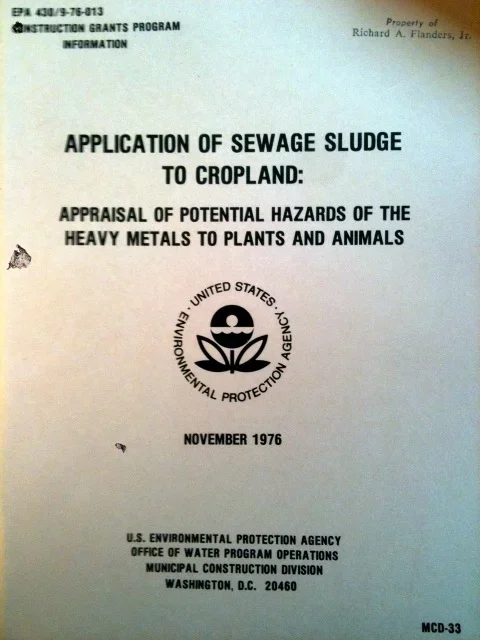
Ongoing focused research on sludge application to soils dates to the 1970s and earlier. There are thousands of peer-reviewed papers regarding benefits and safety concerns.
The Part 503 Regulations
The U.S. Environmental Protection Agency (EPA) published regulations for biosolids at 40 CFR Part 503 in accordance with the Clean Water Act. Details about the 503 rule are available in A Plain English Guide to the EPA Part 503 Rule. The full risk assessment process that led to the final standards found in the 503 regulations can be accessed here: A Guide to the Biosolids Risk Assessments for the EPA Part 503 Rule.
For a copy of the formal February 19, 1993 Federal Register publication of the Part 503 rule, with the full rationale and responses to comments, in a searchable PDF format (it is a large file), contact NEBRA.
Additional EPA information on biosolids is available here.
Use of Reclaimed Water and Sludge in Food Crop Production (1996)
This is the first of two National Academy of Sciences expert panel reviews of the federal biosolids Part 503 regulatory program. It concluded…
"In summary, society produces large volumes of treated municipal wastewater and sewage sludge that must be either disposed of or reused. While no disposal or reuse option can guarantee complete safety, the use of these materials in the production of crops for human consumption, when practiced in accordance with existing federal guidelines and regulations, present negligible risk to the consumer, to crop production, and to the environment." (National Research Council: The Use of Reclaimed Water and Sludge in Food Crop Production," National Academy of Sciences, 1996, p.13.)
Biosolids Applied to Land: Advancing Standards and Practices (2002)
In 2000, the U.S. Environmental Protection Agency (EPA) asked the National Academy of Sciences to "review information on the land application of sludge and evaluate the methods used by the U.S. EPA to assess risks from chemical pollutants and pathogens in sludge." The Academy convened another National Research Council (NRC) panel that released its final report, Biosolids Applied to Land: Advancing Standards and Practices, in July, 2002:
“There is no documented scientific evidence that the Part 503 rule has failed to protect public health. However, additional scientific work is needed to reduce persistent uncertainty about the potential for adverse human health effects from exposure to biosolids. There have been anecdotal allegations of disease, and many scientific advances have occurred since the Part 503 rule was promulgated. To assure the public and to protect public health, there is a critical need to update the scientific basis of the rule to (1) ensure that the chemical and pathogen standards are supported by current scientific data and risk-assessment methods, (2) demonstrate effective enforcement of the Part 503 rule, and (3) validate the effectiveness of biosolids management practices." (from Summary, page 3, prepublication copy).
In September, 2002, Dr. Thomas Burke, Chair of the panel that wrote the report, issued a statement clarifying the panel's findings.
"First, we found no evidence of an urgent public health risk from exposure to land-applied biosolids, based on our review of the scientific literature. Currently, there are no studies documenting adverse health effects from land application of biosolids, even though land application has been practiced for years. But this finding was tempered by the fact that few studies are available on human exposure to biosolids, and that, even when they are investigated locally, there are no means of tracking health allegations nationally."
In 2003, EPA responded to a petition that urged a moratorium on the use of biosolids on soils. The petition cited several cases that they claimed indicated harm from biosolids. In its response, EPA refuted the claims of the petitioners, undermining their allegations with contrary evidence from each case they cited. EPA's response is available here.
In the years since the 2002 National Academy study, research scientists and U. S. EPA have continued to evaluate the potential risks to human health and the environment from use of biosolids on soils. There continue to be no findings of significant harm from biosolids recycled in accordance with regulations and best practices. The potential risks being evaluated by that research—such as microconstituents in biosolids—are very much smaller potential risks than those that were addressed by the original EPA risk assessment for elements and chemicals and by the later dioxin risk assessment.
Today, research and experience are fine-tuning the practices of biosolids recycling, further advancing best practices. For example, further improving understanding of the environmental relevancy of various forms of phosphorus in soils.
Because of more than 40 years of research and experience, biosolids recycling to soils has become a mainstream way of managing the necessary byproducts of necessary wastewater treatment.
Biosolids Recycling to Soils:
Online Scientific Resources
ACS/CSSA/SSSA International Meetings
In recent years, many presentations at this prestigious international conference have been recorded, and there are many presentations related to biosolids and other organic residuals used on soils. Click here to choose a year, then search each page of the author index using the word "biosolids" or whatever you are seeking.
Since the 1970s, major land grant universities, government agencies, and others around the U. S. have studied use of biosolids in agriculture and for other applications to soils. Thousands of research papers have been published in peer-review research journals. Scores of university extension publications have addressed various aspects of biosolids use. Below is a sampling of research summaries available online regarding the potential risks, safety, and benefits of biosolids use on soils.
Note that, at the end of most of the following documents, there is a list of references that includes peer-reviewed published research. Such references to a body of scientific work is the hallmark of sound science. These documents are not based on one or two findings or the opinions of a few people; they are built on the developing understanding of many scientists.
For more information or help finding any of these resources, contact the NEBRA office.
Articles & support material
Pennsylvania State University’s fact sheet series on biosolids effects, biosolids use, and biosolids quality.
Biosolids research from Colorado State University led by Dr. Ken Barbarick, Professor of Soil Science
George O'Connor, PhD, Professor of Soil and Water Science at the University of Florida, offers over 130 peer-reviewed publications, much on biosolids research. Dr. O'Connor summarizes some of that research in this video lecture on Organic Contaminants in Biosolids.
IFAS Extension: Food Safety on the Farm: Good Agricultural Practices: Manure and Municipal Biosolids
Biosolids information compiled by Sally Brown, PhD, Research Associate Professor at the University of Washington’s School of Forest Resources
Cooperative Extension discussion of biosolids concerns by Greg Evanylo, PhD, Professor, Dept. of Crop & Soil Environmental Sciences at Virginia Tech
Charles Gerba, PhD and Ian Pepper, PhD have conducted extensive research on pathogens in biosolids at the University of Arizona. Here is a summary of one project on pathogens and bioaerosols and another evaluation of 20 years of land application of biosolids.
Extension publication on Safety and Benefits of Biosolids
Washington State University’s webpage and resources on Biosolids Management
A news release from the Soil Science Society of America about use of soil amendments for urban gardening
The waste management program of North Carolina State University’s Soil Science Department continues biosolids research.
Extension publication Utilizing Biosolids on Agricultural Land by Lee Jacobs, PhD, Professor Emeritus, Dept. of Plant and Soil Sciences (began biosolids research in 1974) from Michigan State University
Extension publication A Sustainable Approach to Recycling Urban and Agricultural Organic Waste from New Mexico State University
The Water Environment Research Foundation sponsors research by independent universities and researchers on biosolids and wastewater topics (see here). A list of WERF's biosolids research from 1992-2015 is here.
Rufus Chaney, PhD has published hundreds of papers and book chapters on biosolids since the 1970s for the U. S. Dept. of Agriculture. See this video of lecture by Dr. Chaney regarding heavy metals in biosolids.
Purdue University’s 1994 extension publication Land Application of Municipal and Industrial Biosolids
New York's land grant university provides important recommendations to farmers. Because of the work of the Cornell Waste Management Institute (CWMI), which has argued for even greater safety margins in the regulation and management of biosolids, Cornell's recommendations to farmers for "sludge" use are some of the most stringent on the continent. Yet pretty much all biosolids products in use today can meet these very conservativeCornell Extension recommendations. Note that the NY Dept. of Environmental Conservation published a thorough rebuttal to the 1997 CWMI "Case for Caution" report, clearly demonstrating that CWMI's arguments for stricter regulation of trace elements (heavy metals) in biosolids were not supported by the preponderance of science. (Contact NEBRA for copies of these documents.)
At University of California, Riverside, Albert L. Page, PhD, Professor Emeritus, Dept. of Environmental Sciences offers decades of research, including on biosolids (examples here).
The Canadian Council of Ministries of the Environment has sponsored recent biosolids research projects and offers useful publications that include extensive literature reviews and lists.
For Ohio State University’s extension fact sheet Land Application of Waste, Nicholas Basta, PhD, Professor, School of Environment and Natural Resources, was lead author of the literature summary: Basta, N.T., J.A. Ryan, and R. L. Chaney. 2005. Trace element chemistry in residual-treated soil: Key concepts and metal bioavailability. J. Environ. Qual. 34: 49-63—an important review of key concepts derived from many studies from the last four decades on trace element chemistry and phytoavailability in biosolids-treated soil (contact NEBRA for a copy).
American Society of Microbiology’s Land Application of Organic Residuals: Public Health Threat or Environmental Benefit?
The Virginia State Health Department conducted a review of the potential public health impacts of biosolids use and found no reason for the practice to be discontinued.
Every 10 years since the 1970s, U. S. EPA, USDA, and land grant universities have convened an international conference on the state of the science regarding application of biosolids and other organic residuals to soils:
The University of Illinois released a book of technical papers in 1973 entitled Recycling Municipal Sludges and Effluents on Land
In 1983 the University of Colorado compiled technical papers
The University of Minnesota released a book of technical papers in 1993 entitled Sewage Sludge: Land Utilization and the Environment
In 2004 the University of Florida released proceedings/technical papers published in a special edition of the Journal of Environmental Quality (Vol. 34 / #1, Jan-Feb 2005)
In July 2014 the Soil in the City Conference in Chicago, IL released proceedings/technical papers published in a special edition of the Journal of Environmental Quality (Vol. 45, pp. 2 -8, January 2016). Download the summary paper here.
Long-term research and demonstration sites
Several biosolids land application sites have had ongoing applications of biosolids for 20 years or more, during which research has been conducted to determine any potential long-term impacts. These sites include:
The University of Minnesota’s research conducted at the Rosemount watershed study area yielded many published papers.
Starting in the 1970s, Chicago biosolids land reclamation and land application sites in Fulton County, IL have had regular monitoring ever since. The results: many published papers.
William Sopper, PhD, former Professor at Penn State Univ., studied "sludge" (as it was known then) used for land reclamation at devasted coal mine sites in Pennsylvania. His research—compiled in the 1993 book Municipal Sludge Use in Land Reclamation—evaluated impacts on soils, plants, small mammals, birds, and surface and ground waters for a period of 20 years (back to the early 1970s). He found negligible negative impacts and demonstrated significant long-term improvements in restoring native ecosystems. Today's biosolids are of higher quality and their management has improved further since Dr. Sopper's research. Similar successes with land reclamation have been repeated around the United States, and many of those sites have been evaluated for impacts on plants and animals with similar findings.
Denver’s Metrogro Farm in eastern Colorado, owned by the Denver Metro wastewater treatment utility, has had biosolids applications annually for years. It has been the site of routine monitoring by U. S. Geological Society scientists. Their reports are online (one example).
Biosolids from wastewater treatment facilities in King County near Seattle, WA have been land applied for decades. Ongoing research is conducted by the University of Washington, Washington State University, and Arizona State University. See the King County research summary webpage.
The NEBRA office has additional information, references, and referrals.
